Commissioners Work to Ease Residents’ Concerns Over Property Notices
Published on August 31, 2026
Dougherty County Commissioners Work to Ease Residents’ Concerns Over Property Assessment Notices
Residents’ questions prompt Board discussion on assessments, HB 581, homestead protections and the county’s role in property taxes
ALBANY, Ga. — Concerns raised by a Dougherty County resident about recently mailed property assessment notices prompted a broader discussion Monday as members of the Dougherty County Board of Commissioners worked to provide clarity and ease concerns about what higher property values could mean for taxpayers.
Dougherty County resident Dawn Taylor appeared before the Board seeking answers not only for herself, but also for other property owners who have expressed confusion and concern after receiving their 2026 Notices of Assessment.
The notices follow Dougherty County’s first comprehensive property revaluation in more than 10 years. As a result, many property owners are seeing significant changes in their properties’ fair market values.
Taylor told commissioners that residents need greater education and clearer guidance about the assessment and property tax process, particularly regarding which governmental entity is responsible for property values, millage rates, homestead protections and the school system’s portion of property taxes.
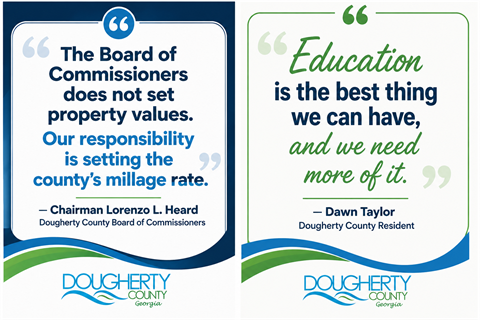
“Education is the best thing we can have, and we need more of it,” Taylor told commissioners as she asked the Board to help residents better understand the process and where they should take their questions.
Taylor also acknowledged District 1 Commissioner Ed Newsome, who represents her district, for taking time before the meeting to discuss her concerns and help explain the process. While appreciative of the assistance she received, Taylor emphasized that many other residents may have similar questions and need clear, accessible information.
Her comments moved the conversation beyond an individual assessment and highlighted a broader concern: helping Dougherty County residents understand a complicated property tax process that involves multiple taxing authorities and recent changes in state law.
Chairman Lorenzo L. Heard, who led much of the Board’s discussion, emphasized one of the most important distinctions for property owners to understand — the Dougherty County Board of Commissioners does not determine property values.
“The County Commission has nothing to do with setting valuations,” Heard said. “The only part that we do is setting the millage rate.”
Property assessments are determined by the Dougherty County Board of Assessors, a separate entity from the Board of Commissioners.
Heard acknowledged that some residents have received notices reflecting substantial increases and encouraged property owners who believe their property has been overvalued to use the appeal process.
“If your valuation is double or triple, you ought to appeal,” Heard said, adding that his own family is appealing a significant increase in the value of property it owns.
Heard also addressed one of residents’ biggest concerns — whether a substantially higher assessment will automatically result in an equally substantial increase in county property taxes.
He said he intends to support a rollback of the county millage rate as the Board moves through the tax digest and millage-setting process.
“I intend, in that movement, to roll back the millage rate,” Heard said.
The final millage rate has not yet been established. The Board will consider the millage rate after the assessment and appeal process is completed and the tax digest is finalized.
District 3 Commissioner Clinton Johnson expanded the discussion by addressing House Bill 581, the state property tax legislation that established Georgia’s statewide floating homestead exemption.
Johnson emphasized that one of the most important things residents should remember is printed on the assessment notice itself: The notice is not a property tax bill.
“This is not a bill,” Johnson said. “This is strictly an assessment.”
HB 581 generally limits annual increases in the taxable value of qualifying homesteaded property for participating taxing authorities based on an inflationary adjustment. The legislation also allowed counties, municipalities and school districts to separately determine whether to participate in the statewide exemption.
Johnson said county officials anticipated changes resulting from the legislation while developing the county budget.
“When we set our last budget, we set a budget that mirrored the 2025 budget because we knew that we weren’t going to be able to realize any new gains,” Johnson said. “So, we kept our budget flat.”
Johnson also encouraged Taylor and other residents to continue engaging with their local elected officials.
“I think what you can do to help us is what you’re doing now — being engaged and coming to our meetings,” Johnson said.
District 5 Commissioner Gloria Gaines addressed Taylor’s questions about homestead protections and the different taxing authorities that contribute to a property owner’s overall tax bill.
That distinction is particularly important under HB 581 because Dougherty County government and the Dougherty County School System are separate taxing authorities.
The Dougherty County Board of Education elected to opt out of the statewide floating homestead exemption established by HB 581 after conducting public hearings on the issue. In information provided by the school system, the Board of Education cited concerns about the legislation’s long-term financial implications, potential effects on state funding and the possibility of shifting a greater share of the property tax burden to investment, commercial and industrial properties.
The school system also stated that opting out of the HB 581 statewide exemption does not eliminate existing homestead exemptions.
Gaines encouraged residents to understand those distinctions and, when their concerns involve the school system’s portion of property taxes, to direct those questions to the Board of Education.
She also emphasized the importance of helping residents get their questions to the appropriate office, noting that commissioners have already been fielding calls from constituents and helping connect them with tax officials who work with assessments and appeals.
“We’ve got to get that message out there,” Gaines said. “We’re going to put something out there so that it will help you understand better.”
Taylor welcomed the Board’s commitment to additional public education, particularly for residents who may not routinely follow government meetings, websites or social media.
Her appearance underscored a point commissioners returned to throughout the discussion: Understanding a property assessment requires knowing the responsibilities of several different governmental entities.
The Dougherty County Board of Assessors determines fair market values, administers property assessments and handles assessment appeals. The Dougherty County Board of Commissioners adopts the county budget and establishes the county millage rate. The Dougherty County Board of Education separately establishes the millage rate for the school system’s portion of property taxes.
Commissioners encouraged residents to carefully review their assessment notices and not mistake them for tax bills.
A Notice of Assessment provides the property’s fair market value, applicable homestead information and appeal information. Actual property taxes are determined later, after the appeal period concludes, the tax digest is finalized and the applicable millage rates are established.
Property owners who disagree with their assessed value have 45 days from the mailing date of the notice to file an appeal. The deadline to appeal the 2026 assessment is Oct. 5, 2026, at 11:59 p.m.
For Taylor, making sure residents understand those distinctions was at the heart of her appearance before the Board.
For commissioners, her questions provided an opportunity to reinforce a broader message to Dougherty County property owners: A higher assessment does not automatically mean an equivalent increase in property taxes. Review your notice, understand your rights, ask questions and file an appeal if you believe your property has been incorrectly valued.
Dougherty County will continue providing educational information about property assessments, appeals, homestead exemptions and the millage-setting process through the county website and social media platforms.
Residents with questions about property assessments or appeals may contact the Dougherty County Board of Assessors at 229-431-2130 or DocoAssessor@dougherty.ga.us.
###